Two Galaxies, One Cosmic Magnifying Glass! Hubble Sets the Stage for the Roman Telescope
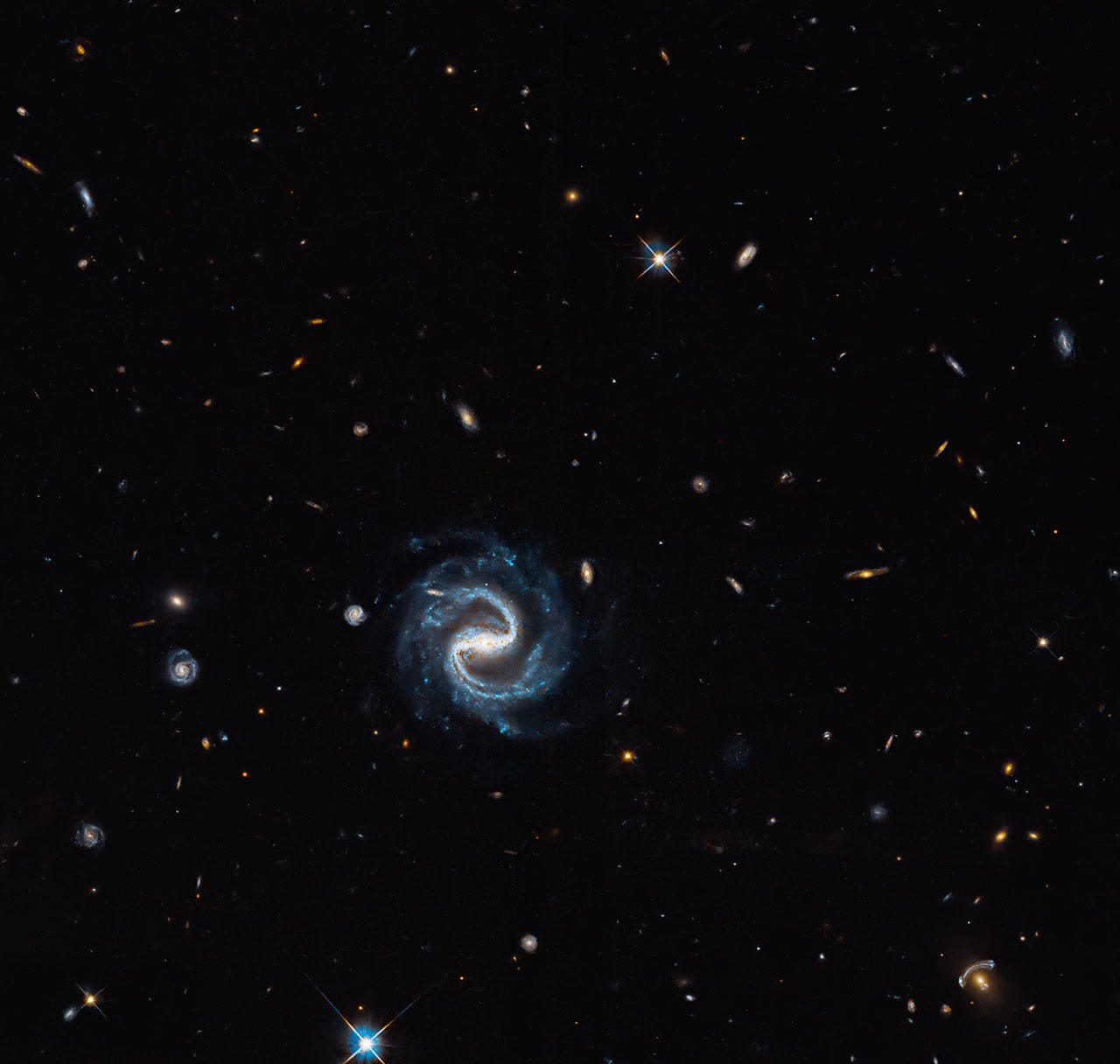
NASA released a Hubble observation in which the gravity of a nearby galaxy magnifies and distorts the light of a much more distant one. The image is part of work that will help the Nancy Grace Roman telescope study gravitational lenses and dark matter. The lensing galaxy is about 4.5 billion light-years away, while the background galaxy is about 8 billion.
The universe can work as a natural telescope. When the gravity of a massive galaxy bends space-time, the light from an object behind it changes path and can appear magnified or duplicated. On October 22, NASA presented a Hubble image showing an elliptical galaxy in the foreground and two blue arcs corresponding to a single distant galaxy. This configuration, called an arc and counterarc, makes it possible to study how mass is distributed in the galaxy that produces the effect.
The foreground object is approximately 4.5 billion light-years away and the magnified galaxy is about 8 billion. The observed distortion helps estimate mass that cannot be explained by visible matter alone, an important tool for investigating dark matter. Hubble provides detailed observations of individual objects, while the Nancy Grace Roman telescope will cover much larger regions of the sky. Researchers are using precise Hubble images to develop models that will make it easier to analyze large future Roman samples. The finding shown is not a direct detection of dark matter, but a measurement of its possible gravitational effects.