An explosion from 12.5 billion years ago! Webb detects a possible newborn supernova
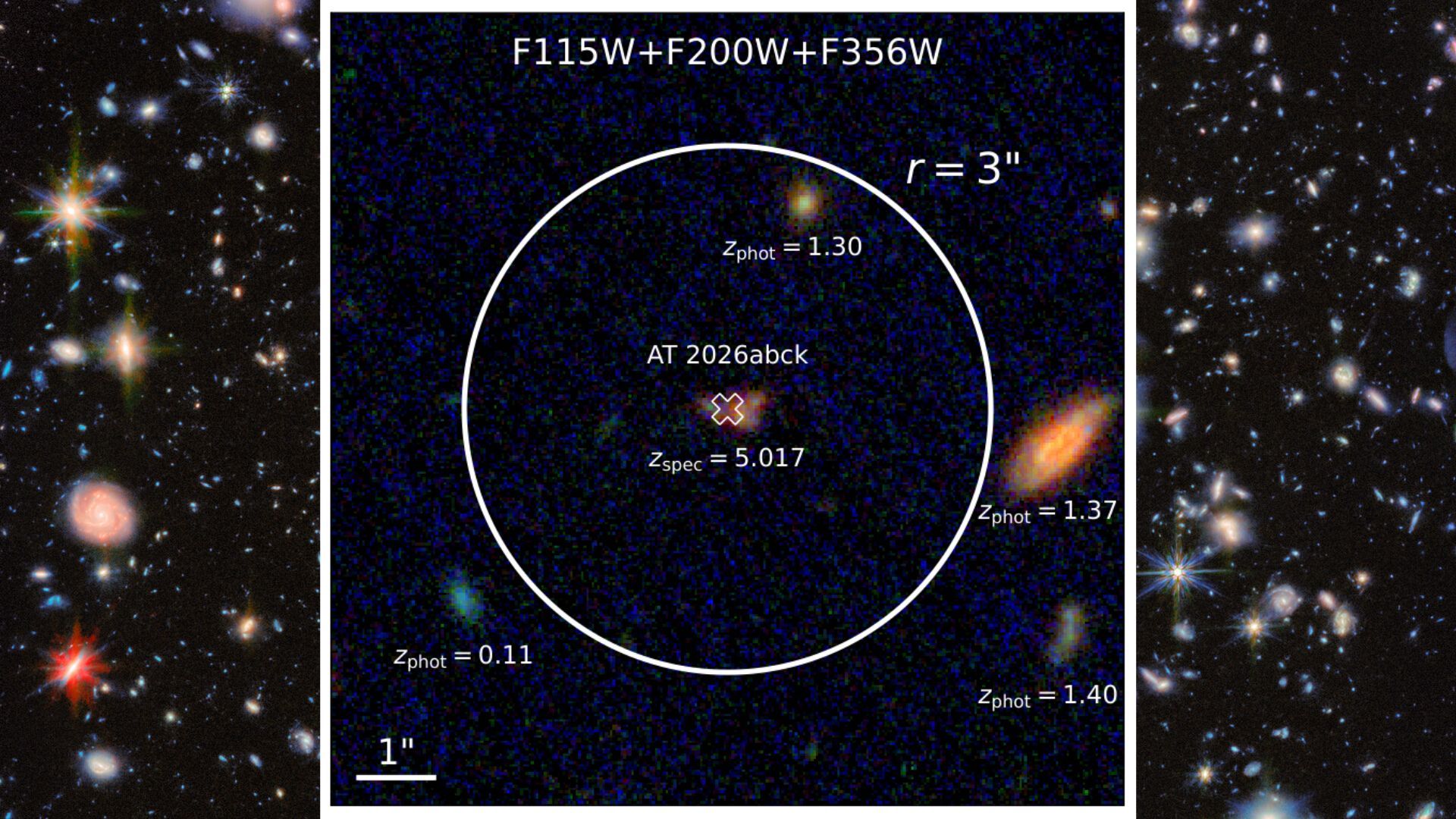
The James Webb Space Telescope identified a luminous phenomenon, designated AT 2026abck, that could correspond to a supernova that occurred when the universe was about 1.15 billion years old. Researchers estimate that the signal was observed between four and ten days after the explosion, measured in the source's time frame. The finding is still preliminary and requires additional observations to confirm the nature of the event.
Observing the early universe also means observing its past. Light from extremely distant galaxies takes billions of years to reach us. The NEXUS program uses repeated observations from the James Webb telescope to identify objects that change in brightness and to detect rare events in young galaxies. During an observation on August 7, 2026, the team recorded AT 2026abck in a galaxy with a redshift of close to five.
The signal appeared without the help of a gravitational lens. The team considers the object's temperature, luminosity and position to be consistent with a stellar explosion, possibly more energetic than an ordinary supernova. Estimates place the detection between four and ten days after the start of the explosion in the source's local time. Because of cosmic expansion, the changes appear about six times slower when seen from Earth. The study was published as a preprint on September 29 and had not undergone peer review when Live Science released its coverage on October 20. New observations will need to determine what type of phenomenon produced the light.