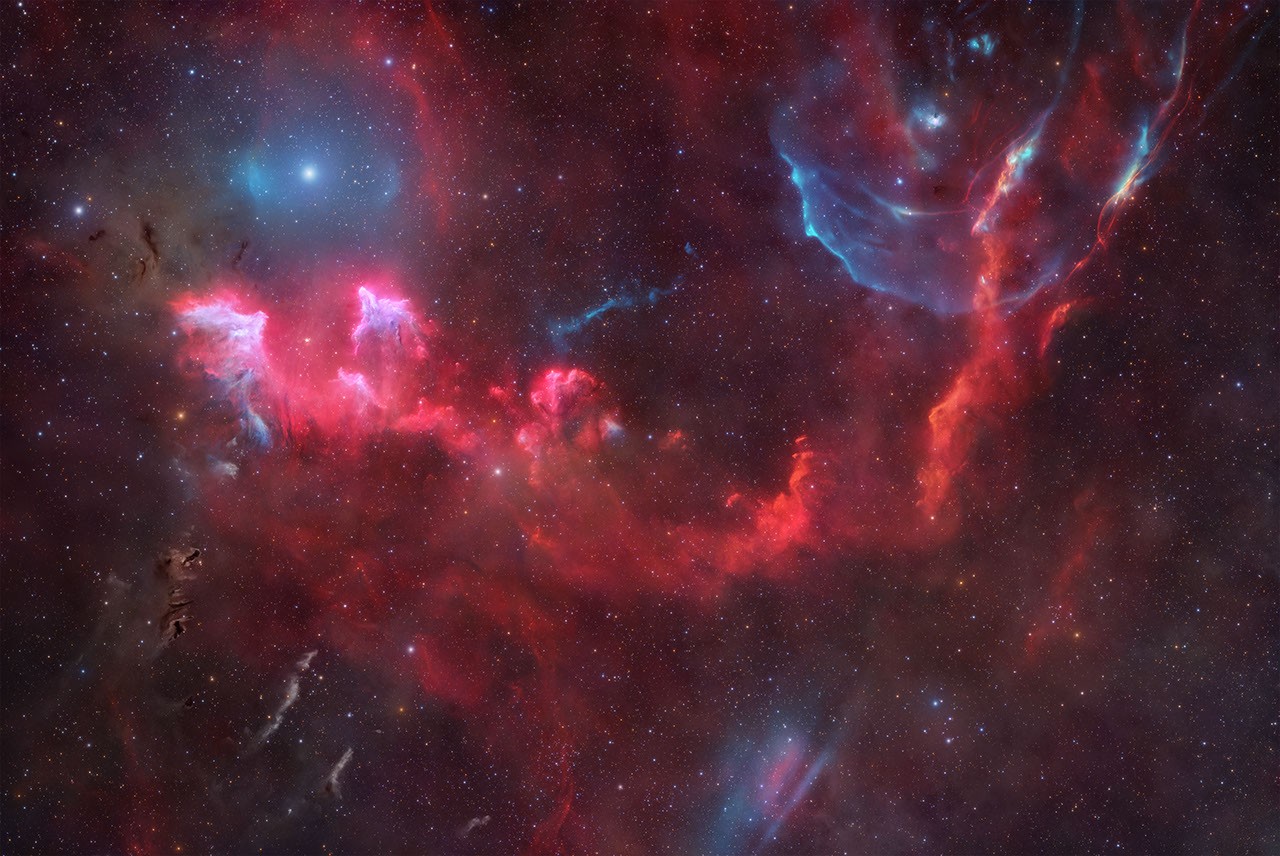
Three cosmic ghosts appear in Cassiopeia after a hundred hours of observation!
An astronomical photograph published by NASA revealed three extremely faint nebulae near the so-called Ghosts of Cassiopeia. The image required about a hundred hours of observation and a filter specialized in oxygen emission. Although interesting structures were detected, astronomers have not yet determined their origin with certainty; hypotheses include gas compressed by a shock wave and a possible planetary nebula.
A well-known region holds more structures. The nebulae IC 59 and IC 63 lie near the Gamma Cassiopeiae star system and are informally known as the Ghosts of Cassiopeia. Their gas can glow due to radiation from nearby stars, while dust scatters light and produces bluish tones in astronomical photographs.
Observing faint objects takes patience. The new image published on Astronomy Picture of the Day required about a hundred hours of exposure and a filter that highlights light from ionized oxygen. Thanks to these techniques, the authors distinguished three objects provisionally labeled 1, 2 and 3, structures that are difficult to identify in conventional observations.
The explanations remain open. NASA suggests that the third object could be related to a shock wave caused by the star system's motion through interstellar gas. The first could be a planetary nebula if a central white dwarf is identified. These possibilities still require further observations and analysis. The image represents an interesting scientific opportunity, but not a definitive confirmation of the physical nature of the three structures.