Social Media vs Website: What Does Your Business Really Need?
Many businesses ask themselves the same question:
“Why would I need a website if I already have Instagram, Facebook, or TikTok?”
And that question is completely valid. Today, for many brands, social media is the first place where customers discover them, browse their products, or send them a message.
But here is the important point: social media does not replace a website.
They serve different purposes. And when used together properly, they can become a very powerful combination.
First things first: social media is not your home
Social media is excellent for giving you visibility. It helps you show up, connect, entertain, and stay present in your customers’ daily conversations.
But it also has one major problem: it does not belong to you.
Your reach depends on an algorithm. Your posts compete with hundreds of distractions. Your profile can change format, lose visibility, or even get suspended. On top of that, your entire presence depends on a platform you do not control.
A website works differently.
Your website is your own space. You decide how it looks, what information appears first, how people contact you, what you sell, what you highlight, and what action you want the user to take.
In other words:
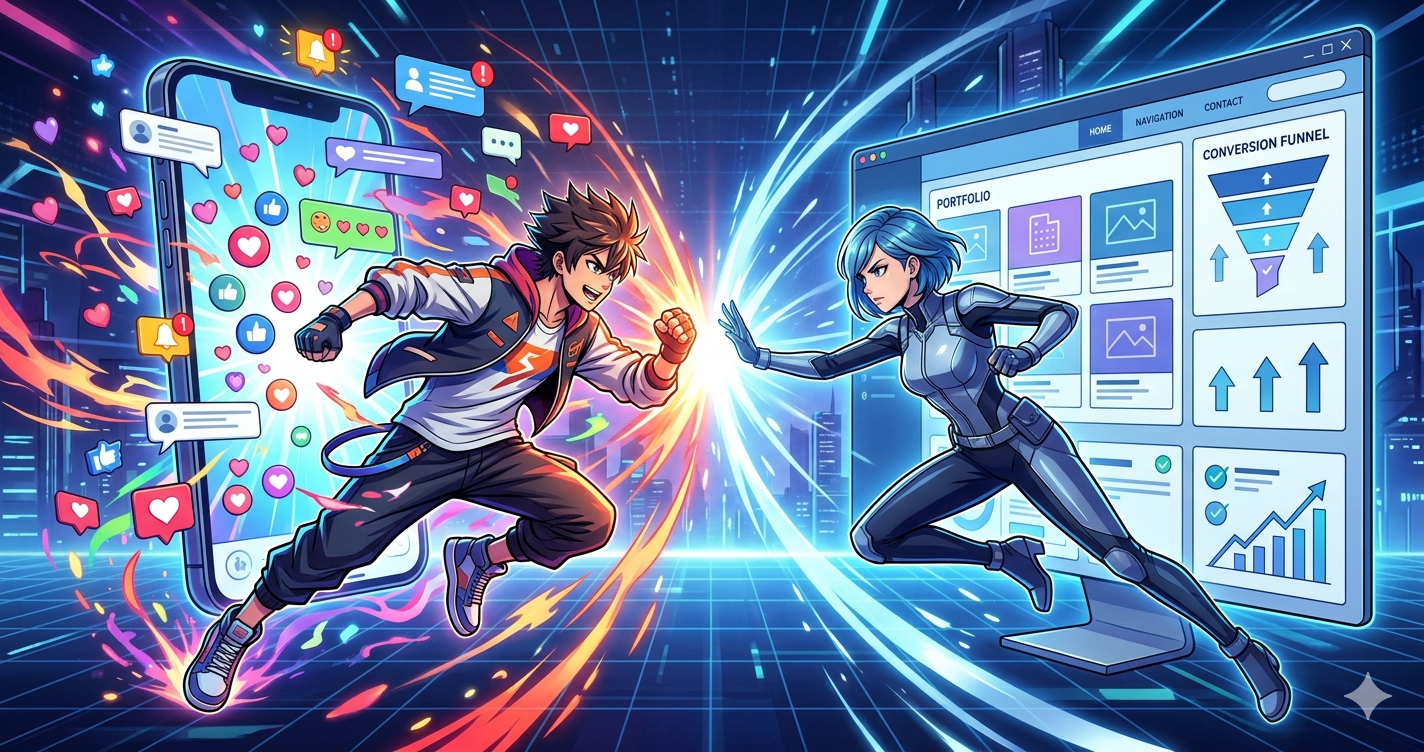
social media borrows you attention; your website gives you control.
So, what does each one do best?
What social media does well
Social media is very good for:
- attracting quick attention;
- building closeness with your audience;
- sharing frequent content;
- receiving direct messages;
- building community;
- helping people discover your brand.
It is ideal for the day-to-day. For staying visible. For creating movement.
What a website does better
A website is better for:
- clearly explaining what you do;
- creating more trust and professionalism;
- appearing on Google when someone searches for your services;
- capturing leads with forms or CTAs;
- selling products or services;
- centralizing important information;
- measuring results with analytics;
- scaling without depending on a single social network.
While social media grabs attention, a website turns that attention into more concrete action.
The biggest problem with relying only on social media
Many businesses live entirely on Instagram or Facebook. And that can work for a while, but it also brings very clear limitations.
For example:
- important information gets buried between posts;
- the customer has to search too much to understand what you offer;
- it is not always clear how to buy or hire you;
- if you switch platforms or your reach drops, you lose traction;
- you appear less solid to more demanding clients.
This happens a lot with small and medium-sized businesses: they have good products, good service, and even an active community, but they do not have a site where everything is organized, clear, and designed to convert.
And that is where the leaks begin.
A website builds trust in a different way
There is something that is still true in 2026:
when someone lands on a well-made website, they feel they are looking at a more serious business.
Not because social media is bad, but because a website communicates stability.
Having a page with your services, case studies, frequently asked questions, contact methods, and well-placed calls to action gives the customer a sense of order. Of support. Of professionalism.
Especially if you sell services, custom solutions, higher-value products, or want to attract more formal clients, a website stops being optional and becomes part of the trust you project.
But this does not mean abandoning social media
This is where many comparisons get it wrong: they frame it as if one had to replace the other.
It is not social media or website.
The best strategy is usually social media and website.
Social media attracts.
The website receives, explains, and converts.
For example:
- someone discovers you on Instagram;
- they visit your profile;
- they click a link to your website;
- they land on a clear page;
- they understand what you offer;
- they fill out a form or message you with real intent.
That journey works much better than trying to keep the entire experience inside a social platform.
What makes more sense for a business that is just getting started?
If you are just starting out, social media can help you move quickly and validate interest. It is accessible, easy to update, and great for beginning to build an audience.
But if you want to grow with more structure, depend less on the algorithm, and have a stronger digital foundation, you need a website.
It does not have to be huge or expensive.
It just has to be well thought out.
A good starter website can include:
- a clear explanation of what you do;
- your services or products;
- testimonials or examples;
- a WhatsApp button or contact form;
- contact information;
- an optimized structure so people can find you.
That alone moves you from simply “having a presence” to having a real business tool.
So, what does your business really need?
If you want visibility, conversation, and ongoing content, you need social media.
If you want credibility, control, positioning, and conversion, you need a website.
And if you want to grow more intelligently, you need both working together.
Social media is an excellent entry point.
A website is where that attention becomes an opportunity.
In summary
Social media is valuable, but it should not be the only digital pillar of your business.
It is fast, dynamic, and close to your audience.
But it is also borrowed space.
Your website, on the other hand, is your own space. Your base. Your digital operations center.
That is why the question should not be whether one replaces the other.
The right question is: does your business already have a place of its own where all the attention generated by your social media can go?
At Zerep, this is how we see it
At Zerep, we help businesses build digital presence with strategy, not just design.
Because posting on social media is good.
But having a website that turns that attention into clients, bookings, or sales is even better.